
The customer research repository
Every insight, traceable to the words behind it.
Keep interviews, consent, highlights and insights in one searchable repository. An insight can't exist without evidence, and every citation opens the exact span of the transcript it came from.
Free and open source. Bring transcripts as .vtt, .srt or .txt.
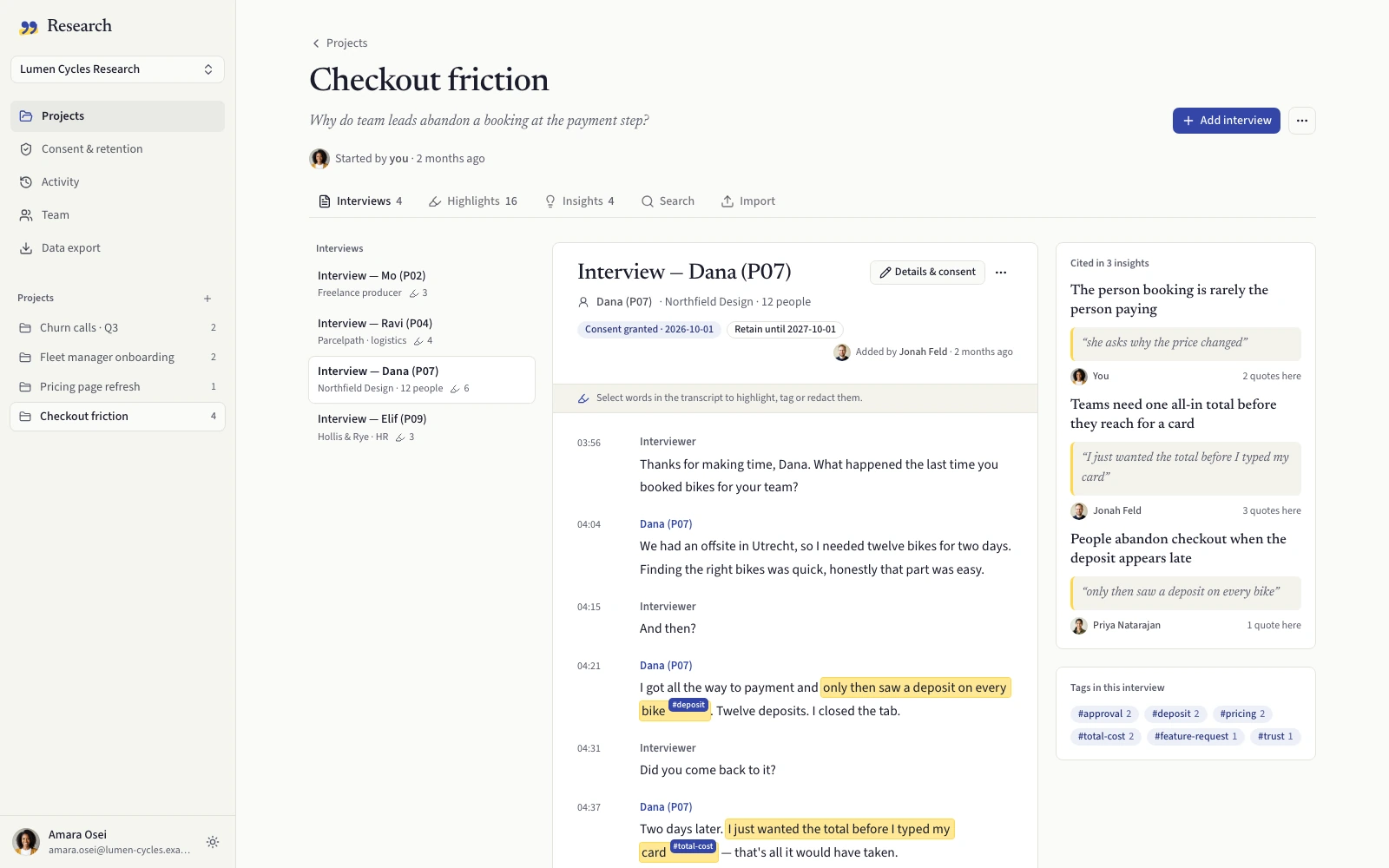
An insight without evidence is an opinion. Research won’t save one.
What you get
A research archive your whole team can trust
Built around one rule: a finding is only as good as the evidence you can show for it.
Highlights that stay put
Select words in a transcript to make a tagged highlight. Fix a typo later and the highlight re-anchors to the same words; every span is validated on the server.
Insights that cite their evidence
An insight can't be saved without evidence. Each backlink jumps to the transcript and marks the exact span, and themes group related insights.
Search that respects access
Ranked, server-side search across a project that only returns what each person may see, with deep links straight into the transcript.
Consent, retention and legal holds
Record consent and retention per participant. Preview a retention run before it deletes anything, and place legal holds that block deletion and redaction.
Folders with real access control
Restricted folders stay hidden from anyone not listed — in the project view, search, exports, reports, version history and the audit log.
Version history for every insight
Every edit makes a new, immutable version with a word-level diff, plus the evidence added or removed and theme changes.
How it works
From raw interview to a finding you can defend
Four steps, and the source chain is kept at every one of them.
Add an interview
Upload or paste a .vtt, .srt or .txt transcript, check the live preview, and record the participant and their consent.
Correct the transcript
Fix text and speakers segment by segment, or rename a speaker everywhere at once. Highlights follow the words.
Highlight and tag
Select what matters and tag it. Tag frequency, renames and merges keep patterns visible as the archive grows.
Write insights, share a report
Cite highlights, group insights into themes, and publish a read-only report that shows each insight with its quotes.
Switching from Dovetail?
Bring your Dovetail archive with you
Import a Dovetail CSV or JSON export. You see how every column maps before anything is written, and a report of what came across afterwards.
- A mapping preview before a single record is written
- An import report that lists what came across and what didn't
- Transcripts arrive as speaker and timestamp segments, ready to highlight
Open source, open archive
Your research stays yours
Research is free and open source under the AGPL-3.0. Read every line of the code, and take the whole archive with you whenever you want.
Versioned exports
Export a project or the whole workspace — sources, highlights, insights, themes, the evidence chain, members and audit — as versioned JSON.
An audit trail
Every change is recorded. A redaction keeps who, when, the reason and the length — never the removed words.
Roles enforced on the server
Admins, researchers and viewers. Viewers can read and search; every write they attempt is refused.
Code you can inspect
The full source is public, so your security team can check exactly what happens to participant data.
Questions
What researchers ask first
Give every insight its receipts
Create a workspace, add an interview and write your first insight that cites its evidence.
Create your workspace